
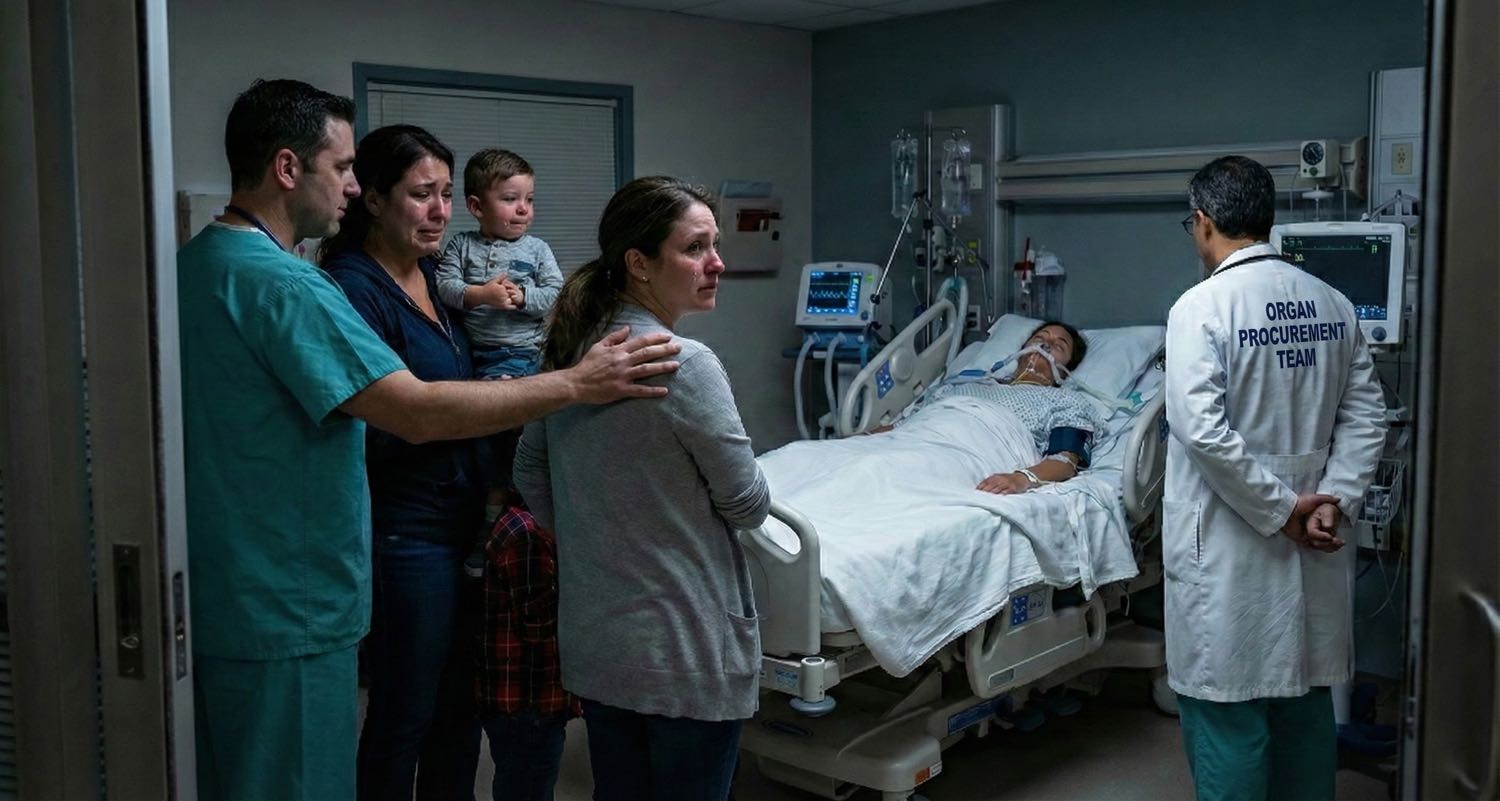
TL;DR: Brain death determination has serious flaws. Only 25% of doctors follow proper testing protocols,[13] 39% of brain-dead patients show movements during testing,[17] and at least 175 documented cases show long-term survival after brain death declaration.[20] The “independent” doctors verifying brain death work for the same hospitals profiting from organ procurement. Families need documented proof of their wishes because updating donor status online often doesn’t work.
Core Facts About Brain Death Determination
- Brain death was defined in 1968, months after the first heart transplant raised ethical questions[6]
- 90% of organ donors receive drugs that suppress movement and consciousness during brain death testing[8]
- No national registry tracks brain death misdiagnoses, making errors “dismissible anecdotes”
- Organ procurement is a $1 billion annual operation in the US, with individual OPOs averaging $2.3 million yearly profit[5]
- Online donor status changes often don’t update DMV records, which hospitals use as authoritative proof
Why This Investigation Started
Something bothered me for months. Victoria’s euthanasia laws made me connect two facts I’d never linked before.
Politicians wanted to force doctors to tell dying patients about assisted death options. At the same time, organ donations from euthanasia patients were climbing fast.
In Europe and Canada, 286 euthanasia patients donated organs by 2021, saving 837 lives.[1]
Spain’s numbers tell the story: 7 cases in 2021. Then 42 cases in 2022. That’s sixfold growth in one year.[2]
By 2024, worldwide euthanasia procedures hit 30,000 annually.[3]
Organ donation makes serious money. A heart transplant costs $190,000 US.[4] Organ procurement organisations average $2.3 million in profits each year.[5]
I hadn’t connected these dots. Then I found a Facebook group called The Right To Fight.
What I found there changed everything I thought I knew about organ donation.
What Families Report About Brain Death Pressure
Thousands of families share the same story in The Right To Fight Facebook group.
Someone has a traumatic brain injury. Doctors declare them brain dead within one or two days. Then comes immediate pressure for organ donation.
Here’s what struck me about these reports.
Every doctor says injuries need rest to heal. But these patients don’t get rest.
They’re alive. They need fluids. They need feeding tubes. They need breathing machines while their bodies recover from massive trauma.
Instead, doctors rush to declare brain death. Then they push for organ donation.
The stories include many people declared brain dead who later recovered. They needed proper medical treatment. The kind patients received before 1968, when brain death was invented.
Bottom line: Families report systematic rushing of brain death declarations, often within 24-48 hours of injury, before adequate recovery time.
When Was Brain Death Invented?
Brain death wasn’t always part of medicine.
August 1968: Harvard Medical School published “A Definition of Irreversible Coma.”[6]
The timing matters.
December 1967: Christiaan Barnard performed the first heart transplant.[7]
This raised an uncomfortable question. Were donors dead when hearts were removed? Or did removing the heart kill them?
Within months, Harvard redefined death itself.
The medical establishment says organ transplantation “developed in parallel” with brain death definitions. They claim transplants weren’t the driving force.
But look at the timeline. The ethical problem emerged. Then the solution appeared. Precisely when the transplant industry needed it.
Key insight: Brain death was defined in 1968, months after the first heart transplant created an urgent need to redefine when donors are “dead enough” for organ removal.
Why Do Dead People Need Pain Medication?
Here’s what grabbed my attention:
- 90% of organ donors receive neuromuscular blockers
- 63.3% receive inhaled anaesthetics
- 33.9% receive opioids, with fentanyl most common[8]
Stop and think about this.
Why do dead people need drugs that suppress movement, pain responses, and autonomic reactions?
The official explanation: these drugs keep organs working well.
That explanation doesn’t work. If someone’s truly brain dead, why fentanyl for pain? If they need Nimbex to stop body movement, what’s trying to move?
The Protocol Nobody Follows
According to testing protocols, doctors must wait after administering these drugs. The drugs need to wear off before conducting brain death tests.
But who checks compliance?
Families don’t know the protocols. No third-party organisation monitors the process. No one without profit motive watches to ensure proper procedures.
What stops organ procurement teams from testing whilst patients remain under the influence of Nimbex, Propofol, and Fentanyl?
Nothing.
The problem: The same drugs that mimic brain death symptoms are administered before brain death testing, with no independent oversight to ensure proper wait times.
What Does “Independent Doctor” Actually Mean?
Brain death requires two independent doctors. Sounds safe, right?
Ask yourself: independent from what, exactly?
You’d assume “independent” means separate from organisations profiting from organ procurement.
That’s not what it means.
The Legal Definition of Independent
Australia’s requirement: “two doctors, neither of whom is caring for a potential organ recipient.”[9]
United States requirement: doctors performing brain death examinations shouldn’t be “part of the transplant team.”[10]
Notice what’s missing?
Neither says doctors must be independent from the hospital profiting from organ procurement.
Here’s what “independent” actually means in practice: two doctors who don’t work in the same department of the same hospital. That’s it. They could be from different departments—neurology and intensive care, for instance—but both employed by the institution that’s about to generate significant revenue from the organs.
Deceased donor organ procurement is a $1 billion per year operation in the United States alone. Profits average $2.3 million per organ procurement organisation per year. Total assets per OPO: $45 million, growing at 9% annually.[5]
In 2016, Medicare reimbursed certified transplant centres $1.6 billion.[11] They charge around $190,000 US for a heart transplant.[4]
Now, you might say these are non-profit organisations. But here’s the thing: the organisation itself doesn’t care if it has money. The individuals in the organisation do.
All these doctors doing the transplants, everyone involved in organ procurement, the administrators overseeing the process—they’re taking home substantial salaries from this billion-dollar operation. When the organisation profits, they profit.
It’s a lie to pretend there’s no financial interest just because you’ve structured something as non-profit.
So when two “independent” doctors declare brain death, both are employed by the same institution that will generate revenue from the organ procurement. Both work for colleagues who benefit financially from successful organ harvesting. Both operate within a system where hospitals are judged partly on their organ donation rates.
Now ask yourself: how long would they keep their jobs if they put the spanner in the works of too many organ donation opportunities?
If a doctor consistently disagrees with brain death declarations, consistently finds reasons why patients don’t meet the criteria, consistently slows down the procurement process—do you honestly think they’ll remain employed?
Their job is essentially to be a doctor from a different department who agrees with the organ donation process. Someone who can be pointed to and called “independent” because they don’t work in the same unit as the first doctor.
But they’re not independent from anything a normal person would consider them independent from. They’re not independent from the profit motive. They’re not independent from institutional pressure. They’re not independent from colleagues whose income depends on successful organ procurement.
The only reason anyone believes they’re independent is because nobody’s ever asked the obvious question: independent from what?
It’s the same pattern you see with euthanasia safeguards. Two different doctors have to sign off—but they’re both employed by the same system, working within the same institutional pressures, subject to the same financial incentives.
The safeguards aren’t designed to protect patients. They’re designed to provide legal cover whilst maintaining plausible deniability.
The Data That Doesn’t Exist
Here’s the thing that really exposes the system: nobody’s keeping count of brain death misdiagnoses.
In the United States, a substantial proportion of patients declared dead by neurological criteria don’t meet the legal standard for death. Researchers examining brain death patients with normal renal function found that 77% exhibited central diabetes insipidus, meaning 23% retained normal hypothalamic osmoregulatory function—evidence of ongoing brain activity.[12]
Yet there’s no national registry tracking these contradictions.
When something happens a million times but nobody’s putting it into a spreadsheet, you’ve still only got a million anecdotes. Because nobody’s counting, it can’t become a statistic.
And why is that the case? Because if someone’s counting, then it becomes evidence. If nobody’s counting, then even documented cases remain dismissible stories.
The Safeguards That Aren’t
Despite the vast majority of doctors reporting competency in performing brain death testing, only 25% conduct testing in accordance with current practice guidelines.[13]
Ten percent of providers don’t perform an apnea test—the omission of which constitutes an incomplete and incorrect performance of brain death examination.[13]
Even more damning: of providers who obtained ancillary tests on an as-needed basis, more than a quarter ordered them if the patient breathed during apnea testing—a finding inconsistent with brain death. This suggests misdiagnosis may be more common than previously assumed.[13]
The Lazarus Effect They Don’t Want You to See
Here’s something that sounds like it should be front-page news but somehow never makes it into public discussion: the Lazarus effect.
Imagine you’re lying on the organ donation table. You’ve been declared brain dead. They’re about to remove your organs. Then you lift your arms and cross them over your chest—a complex, coordinated movement that looks exactly like someone trying to protect themselves.
What do the doctors say? That’s just a spinal reflex. It proves you’re dead, not alive.
Read that again. A complex protective movement—lifting both arms and crossing them over your chest—is dismissed as a meaningless spinal twitch. The very action that should scream “this person is conscious and terrified” is redefined as proof of death.
This is mental gymnastics of the highest order.
The Lazarus effect occurs most commonly during the apnoea test—the test where they disconnect you from the ventilator to see if you’ll breathe on your own. Think about what this means: you’ve had a massive car crash. You’re so badly injured you can barely move, including the muscles around your ribcage. You can’t breathe without mechanical support.
That’s precisely what the breathing machine is for—to support you whilst you’re so badly injured you otherwise couldn’t breathe.
But then the doctors perform their brain death tests. And during the apnoea test, they take you off that breathing support. Your oxygen drops. Your carbon dioxide rises. And in that moment of suffocation, you lift your arms to protect yourself.
The response? “That proves you’re brain dead.”
When I first read about this, I thought it must be extraordinarily rare. If you search Google for “What is the Lazarus effect?”, Google’s AI cheerfully tells you it’s “a rare but documented medical phenomenon.”
Rare. That’s the word they use.
Then I looked at some actual medical studies. Researchers prospectively evaluated 38 patients who fulfilled the criteria for brain death using a standardised protocol. They found that 15 patients—39%—exhibited spontaneous or reflex movements.[17]
The most common was finger jerks. But they also documented undulating toe flexion, triple flexion response, the Lazarus sign (arms raising and crossing the chest), pronation-extension reflex, and facial myokymia.
The researchers concluded: “These movements may be more common than reported and do not preclude the diagnosis of brain death.”
Read that last sentence again. Movements occur in nearly 40% of brain-dead patients, and the official position is that this “does not preclude the diagnosis.”
So when Google’s AI tells you it’s “rare,” they’re lying. When you ask if it could be 40%, they’ll tell you it’s “definitely not 40%.” But the peer-reviewed medical literature—published in Neurology, one of the most respected journals in the field—says otherwise.[17]
Forty per cent. Nearly half of all brain death determinations involve movements that, in any other context, would be recognised as signs of consciousness and distress.
And here’s the part that really exposes the game: medical guidelines recommend that families be removed from the room during apnoea testing.[18]
Why? Because if families see their loved one lift their arms, move, or show signs of distress when taken off the ventilator, they might object. They might refuse to allow organ donation. They might demand the doctors stop.
So the solution isn’t to reconsider whether these movements indicate consciousness. The solution is to make sure nobody who loves the patient is watching when it happens.
It’s the same pattern as the Facebook groups dismissed as “misinformation.” The real misinformation is preventing families from witnessing what actually happens during these tests. Keep them out of the room. Keep them in the dark. Then gaslight them afterwards if they dare question what occurred.
When Anthony Hoover was crying and moving during organ retrieval, some clinicians still wanted to continue. The system is designed to make as many concerning signs as possible formally deniable. Get it into the rules, into the guidelines, into the law—so that when improprieties occur, the response is: “That’s not my fault. That’s just how the system works. Them’s the rules, mate.”
The safeguards are fake. They say there have to be two different doctors signing off. They say it would never encourage people towards organ donation.
But very quickly it’s gone from that to politicians like Maryanne Thomas in Victoria wanting to make it mandatory that doctors tell patients they have the option of being killed if they want.
The same pattern happened in Canada.
The Cases That Slip Through
Anthony Hoover was declared brain dead. During organ retrieval, he was crying and moving. Some clinicians still wanted to continue the process.[14]
Someone happened to refuse that day. But what about all the times when the people who refused weren’t there? What about when only the people who wanted to continue were present?
And the individuals who refused—have they still got their jobs? Or were they moved out, demoted, transferred to a different clinic?
Amber Ebanks was declared brain dead. Her family and physicians disputed that she met the criteria. They needed court orders to delay withdrawal.[15]
But these aren’t isolated cases. They’re just the ones that happened to make the news. Here are more:[19]
Zack Dunlap (March 2008) – Declared brain dead following an ATV accident. He later recounted hearing doctors discussing harvesting his organs whilst he was paralysed and unable to respond. He recovered.
Val Thomas (May 2008) – Doctors declared her brain dead after detecting no brain waves for more than 17 hours. The family was discussing organ donation when she suddenly woke up and started speaking to nurses.
A 41-year-old woman (2009) – Declared brain dead. Woke up in the operating room just as her organs were about to be removed.
Madeleine Gauron (July 2011) – Quebec woman identified as viable for organ donation after brain death diagnosis. Surprised her family and physicians when she recovered from coma, opened her eyes, and began eating.
An Australian woman (May 2011) – Declared brain dead. Regained consciousness after family fought for weeks against doctor recommendations that her ventilator be shut off.
Carina Melchior (2012) – 19-year-old Danish woman. Doctors declared her brain dead and approached the family about organ donation. She woke up whilst doctors were discussing her case at her bedside. Later featured in the documentary “The Girl Who Refused to Die.”
Colleen Burns (July 2013) – New York woman pronounced brain dead. Unexpectedly awoke just as her organs were about to be removed for transplant.
George Pickering (January 2015) – 27-year-old Texan pronounced brain dead. His father threatened to shoot himself if anyone disconnected life support. During the standoff with police, George repeatedly squeezed his father’s hand. He woke up that evening and made a strong recovery.
A Swedish man (2017) – Declared brain dead. Heard doctors discussing organ donation with his family but couldn’t respond. It took three days until another doctor returned from holiday, looked at his scans, and said “This doesn’t look too bad.” His girlfriend and sister had to fight with the night nurse to give him cortisone. He recovered.
TK – Declared brain dead at age 4 from acute meningitis. Survived for nearly 20 years after declaration of brain death. Underwent proportional physical growth and sexual maturation—features indicating ongoing brain function. His case was confirmed by autopsy.[20]
Jahi McMath (2013) – 13-year-old girl declared brain dead. Family refused to withdraw life support. She continued to grow and went through puberty over several years. As Dr. Alan Shewmon noted: “I’ve never heard of a corpse that underwent puberty before.”[21]
Dr. Alan Shewmon has documented 175 cases of long-term survival after brain death declaration.[20] Thirty pregnant women diagnosed with brain death were kept on life support for weeks or months so their babies could mature—some retained blood pressure homeostasis, robust immune response, and proportional growth.[20]
These aren’t isolated anomalies. These are the cases where someone happened to refuse, where families happened to fight, where doctors happened to wait long enough.
How many didn’t make it? How many times did everyone in the room want to continue with organ procurement, and so they did?
The Gaslighting Playbook
When I asked ChatGPT about this, it told me there’s never been a case of someone being declared brain dead who wasn’t actually brain dead and then had their organs removed. Never happened.
Then it admitted there are lots of cases where doctors mistakenly said someone was brain dead.
That’s what I was talking about in the first place. They said someone was brain dead when they weren’t. Whether it’s a mistake or a lie, the result is the same.
It’s classic gaslighting. “Zero cases” of wrongful brain death becomes “only misdiagnoses” when evidence surfaces. A distinction without difference that protects the system.
The American Academy of Neurology states that “brain death has occurred when the irreversible loss of all functions of the entire brain including the brainstem has been determined.” Yet it endorses the belief that “preserved neuroendocrine function may be present and is not inconsistent with the whole brain standard of death.”[16]
This is a logical contradiction. The system openly admits some brain function persists whilst maintaining patients are dead. It’s a semantic trick that protects institutional interests whilst invalidating concerns about premature organ harvesting.
The Organ Donor Registry Deception
Dianne Nguyen, who created The Right To Fight page, swore with her husband they’d never donate their organs because they’d heard these stories.
“They both immediately went on to removed themselves as organ donors but 2 months later, their worst nightmare came true.
“Francisco J. Villa aka Jay had a sudden brain aneurysm after drinking an energy drink and doctors pronounced him “brain dead” shortly after his coil surgery. But his wife witnessed signs of life such as crying all weekend.
“Life Gift tried to trick his wife into giving consent but she refused many times. They went on to get consent from someone else.”
Here’s the problem: when you fill out the form online to change your donor status, it doesn’t update the DMV. The DMV list is what doctors use as their authoritative source to prove you’re a donor.
They know it’s fake. They know it’s lies. But it’s just one of their many lies.
The Last Channel Standing
When I first looked at this topic, AI assumed I was going to write about how terrible the Facebook groups are for spreading misinformation. How dare anyone question the doctors, the great men in white coats, the Science™.
But here’s the reality: the papers and mainstream media are supported and paid for by medical advertising. They’re not going to investigate. They’re not going to challenge their own advertisers who are paying for their survival.
Doctors won’t talk about it. Anyone who talks about it becomes an ex-doctor. They won’t keep their job.
What’s left? Only social media. Only places like The Right To Fight Facebook group where real people can tell their stories without institutional gatekeeping.
The cases that get reported in larger media outlets—regional news covering Anthony Hoover and Amber Ebanks—are treated seriously. But for everyone else, if a newspaper didn’t pick up their story and it was only said on Facebook, it’s supposedly misinformation.
How dare the great unwashed open their mouths and talk about what happened to them.
The Euthanasia Connection
In Europe, euthanasia is becoming a major source of organ donors. When you’ve got someone who’s been given less than 12 months to live and they choose assisted dying, they’ve likely got organs that are unaffected by their condition.
The system has a vested interest in making euthanasia readily available and ensuring people know about it.
It’s the same pattern. The safeguards erode quickly. What starts as “only if they think of it themselves” becomes “doctors must inform patients of the option.”
The profit motive doesn’t disappear just because you call something non-profit.
What This Means for You
I’m not telling you what to believe about organ donation. I’m asking you to look at the evidence and ask uncomfortable questions.
When no registry tracks misdiagnoses, when “independent” doctors work for hospitals profiting from transplants, when patients declared brain dead receive drugs that suppress consciousness, when documented cases of people showing signs of life are dismissed, when whistleblowers lose their jobs—we’re not looking at a system designed to protect patients.
We’re looking at a system designed to protect itself.
The question isn’t whether organ transplants save lives. They do. The question is whether we’re willing to accept a system with no real accountability, no transparent oversight, and financial incentives that directly contradict patient protection.
When AI, mainstream media, and medical institutions all reflexively defend the same profitable system, and when questioning becomes conspiracy, we’re not looking at science.
We’re looking at ideology protecting its revenue stream.
The families sharing their stories on social media aren’t spreading misinformation. They’re the only ones telling the truth when every official channel has a reason to stay quiet.
And that should terrify you.
What You Can Do Right Now
If, after reading all of this, you’ve decided you don’t want to donate your organs—because you understand that hospitals may view your death as a source of income rather than prioritise saving your life—then simply updating your organ donation status online probably won’t protect you.
In Australia, you can update your status on my.gov.au. In America, there are various websites. Different countries have different systems. But here’s the question nobody asks: who can actually access that record when it matters?
Imagine you have a traumatic injury. You’re in hospital, unconscious. The organ procurement team arrives to tell your family you’re brain dead, there’s nothing to be done, and they should step outside whilst the doctors “finish up.”
How is your family going to prove otherwise? How will they prove you never consented to donation if the hospital claims your DMV record says you’re a donor—even though you changed it online and the update never reached the DMV?
If you want to ensure your wishes are known and enforceable, you need to create evidence your family can use:
1. Screenshot your donor status after updating it online. Don’t just submit the form and hope it works. Capture proof that you changed it, with the date visible.
2. Email the screenshot to your family members. Multiple people. Not just one. Make sure they save it and know where to find it.
3. Record a video of yourself stating clearly: “I do not consent to organ donation. I do not authorise the removal of any organs or tissues from my body after death.” Include the date. Send it to your family.
4. Put it in writing. A signed, dated document stating your refusal to donate organs. Give copies to family members. Keep one with your important documents.
5. Tell your family explicitly that if you’re ever declared brain dead, they have the right to refuse organ donation, demand time, request second opinions from doctors not employed by that hospital, and insist on being present during any testing.
Because if you ever need to fight for your life—if you ever need “The Right To Fight,” as the Facebook group is named—you need to give your family the ammunition to do it.
Without clear, documented evidence of your wishes, doctors can pressure grieving family members, claim you were registered as a donor, and rush the process before anyone has time to question it.
The system is designed to make it easy for organs to be procured and difficult for families to object. The paperwork, the protocols, the “independent” doctors, the removal of families during crucial tests—all of it serves the same purpose: to facilitate organ harvesting with minimum resistance.
Your family will be grieving, confused, overwhelmed. Doctors will be authoritative, urgent, professionally compassionate whilst pushing for a quick decision. Your relatives will be told it’s what you would have wanted, that it’s a beautiful final gift, that other people are dying on waiting lists.
Unless you give them the tools to fight back, they won’t be able to. And by the time they realise something was wrong—if they ever do—it will be too late.
Make your wishes crystal clear. Document them. Share them. Make it impossible for anyone to claim they didn’t know.
Because once you’re declared brain dead, the people who profit from your organs will be in the room. The people who love you might not be.
And that should terrify you even more.
Frequently Asked Questions
Q: Has anyone ever recovered after being declared brain dead?
Yes. At least 175 documented cases show long-term survival after brain death declaration.[20] Specific examples include Zack Dunlap (heard doctors discussing organ harvest whilst paralysed), Val Thomas (woke during organ donation discussion), Colleen Burns (woke before organ removal), and TK (survived 20 years, went through puberty).[19][20]
Q: How accurate are brain death determinations?
Only 25% of doctors conduct brain death testing according to current practice guidelines.[13] 10% skip the apnoea test entirely, which constitutes incorrect diagnosis.[13] 23% of patients declared brain dead retain hypothalamic function, showing ongoing brain activity.[12]
Q: Why do brain dead patients receive anaesthesia and pain medication?
90% of organ donors receive neuromuscular blockers, 63.3% receive anaesthetics, and 33.9% receive opioids like fentanyl.[8] The official explanation is “organ preservation,” but these drugs suppress the same movements and responses used to diagnose brain death. Protocols require waiting periods after administration, but no independent oversight ensures compliance.
Q: What is the Lazarus effect?
The Lazarus effect describes movements during brain death testing, including arms raising and crossing the chest. A medical study found 39% of brain-dead patients exhibited these movements.[17] Medical guidelines dismiss these as “spinal reflexes” and recommend removing families from the room during testing.[18]
Q: Are the “independent doctors” who verify brain death truly independent?
No. “Independent” means they’re not on the transplant team or caring for recipients. It doesn’t mean they’re independent from the hospital profiting from organ procurement. Both doctors typically work for the same institution that will generate revenue from the organs. Organ procurement organisations average $2.3 million yearly profit.[5]
Q: Does updating my organ donor status online protect me?
Often no. Online updates frequently don’t sync with DMV records, which hospitals use as authoritative proof of donor status. Diane Nguyen’s husband changed his status online, but doctors still claimed his DMV record showed donor registration. You need screenshots, videos, and written documents that your family holds.
Q: Is there a registry tracking brain death misdiagnoses?
No. The United States has no national registry tracking brain death misdiagnoses. Without official tracking, documented cases remain classified as “anecdotes” rather than statistical evidence.
Q: When was brain death defined and why?
December 1967: First heart transplant raised ethical questions about when donors are dead.[7] August 1968: Harvard defined brain death.[6] The timing suggests brain death was defined to facilitate organ transplantation, though this was never officially acknowledged.
Key Takeaways
- Brain death testing is deeply flawed: only 25% of doctors follow proper protocols, and 39% of patients show protective movements during testing that are dismissed as reflexes
- “Independent” doctors verifying brain death work for the same hospitals profiting from organ procurement (averaging $2.3 million yearly per organisation)
- At least 175 documented cases show long-term survival after brain death declaration, including patients who went through puberty years after being declared dead
- No national registry tracks brain death misdiagnoses, making systematic errors invisible and dismissible as “anecdotes”
- 90% of organ donors receive drugs that suppress consciousness and movement before brain death testing, with no independent oversight ensuring proper wait times
- Updating donor status online often doesn’t work because changes don’t sync with DMV records that hospitals use as proof
- To protect your wishes: screenshot your status, email proof to multiple family members, record a video statement, create written documents, and explicitly tell family their rights to refuse, demand time, and require doctors from outside the hospital
References
- Mulder J, Sonneveld H, van Dijk N, et al. Practice and challenges for organ donation after medical assistance in dying: A scoping review including the results of the first international roundtable in 2021. American Journal of Transplantation. 2023. https://www.amjtransplant.org/article/S1600-6135(23)00029-1/fulltext
- Bollen J, van Dijk N. Feasibility of organ donation following voluntary assisted dying in Australia: lessons from international practice. Medical Journal of Australia. 2023. https://onlinelibrary.wiley.com/doi/full/10.5694/mja2.52016
- Organ donation after medical assistance in dying. Wikipedia. 2024. https://en.wikipedia.org/wiki/Organ_donation_after_medical_assistance_in_dying
- Bastami S, Matthes O, Krones T, et al. Systematic review of attitudes toward donation after cardiac death. Critical Care Medicine. 2013;41(12):2804-2814.
- The New York Times. “When a Transplant Hospital Must Close, Patients Are Left Adrift.” 2018. Analysis of OPO financial data.
- Ad Hoc Committee of the Harvard Medical School. A Definition of Irreversible Coma. JAMA. 1968;205(6):337-340.
- Barnard CN. The operation. A human cardiac transplant: an interim report of a successful operation performed at Groote Schuur Hospital, Cape Town. South African Medical Journal. 1967;41:1271-1274.
- Joffe AR. Anesthesia for patients declared dead by neurologic criteria (brain death). Anesthesiology Clinics. 2013;31(3):577-588.
- Australian Museum. Defining death. https://australian.museum/about/history/exhibitions/death-the-last-taboo/defining-death/
- Greer DM, Kirschen MP, Lewis A, et al. Pediatric and Adult Brain Death/Death by Neurologic Criteria Consensus Guideline. Neurology. 2023. https://www.neurology.org/doi/10.1212/WNL.0000000000207740
- Organ Procurement and Transplantation Network (OPTN) Financial Data. 2016 Medicare Cost Reports.
- Joffe AR. Are recent defences of the brain death concept adequate? Bioethics. 2010;24(2):47-53.
- Greer DM, Varelas PN, Haque S, et al. Variability of brain death determination guidelines in leading US neurologic institutions. Neurology. 2008;70(4):284-289.
- Multiple news sources including Kentucky Health News regarding Anthony Hoover case, 2021.
- Court documents, Amber Ebanks case, 2023. Multiple media reports.
- American Academy of Neurology Position Statement on Brain Death. Updated 2010. https://www.ncbi.nlm.nih.gov/books/NBK545144/
- Saposnik G, Bueri JA, Mauriño J, Saizar R, Garretto NS. Spontaneous and reflex movements in brain death. Neurology. 2000;54(1):221-223. doi: 10.1212/wnl.54.1.221. PMID: 10636153. https://pubmed.ncbi.nlm.nih.gov/10636153/
- ANZICS Statement on Death and Organ Donation. Edition 4.1, 2022. Guidelines regarding family presence during apnoea testing.
- Multiple documented cases compiled from: KGOV.com List of Brain Dead Patients Who’ve Recovered https://kgov.com/brain-dead-patients-who-have-recovered; Joffe AR, et al. Brain death and true patient care. PMC. 2016. https://pmc.ncbi.nlm.nih.gov/articles/PMC5102188/
- Repertinger S, Fitzgibbons WP, Omojola MF, Brumback RA. Long survival following bacterial meningitis-associated brain destruction. Journal of Child Neurology. 2006;21(7):591-595. Also: Shewmon DA. Chronic “brain death”: Meta-analysis and conceptual consequences. Neurology. 1998;51(6):1538-1545. https://pmc.ncbi.nlm.nih.gov/articles/PMC5102206/
- Shewmon DA, as quoted in: Debate simmers over when doctors should declare brain death. NPR. February 11, 2024. https://www.npr.org/sections/health-shots/2024/02/11/1228330149/brain-death-definition
Leave a Reply